
If you have ever managed a commercial building, a busy apartment complex, or a sprawling industrial yard, you already know the massive headache that comes with keys. It is a non-stop puzzle. You have got tenants moving out of nowhere, new employees coming on board, contractors needing to get in for just a day, and delivery drivers constantly stuck at the front gate blocking actual street traffic.
Property management has changed a lot recently, though. Nobody wants to deal with messy physical keychains anymore or localized software that only works on one old, dusty desktop computer sitting in a back office. Instead, managers want centralized control. They need to see everything at once without leaving their desk.
That is exactly where LiftMaster Access Control comes into play. By tying high-quality gate operators and physical entry points into modern digital networks, it lets you run multiple properties from one single dashboard. Let’s break down exactly how it works, why it matters, and how it completely changes the day-to-day operations for property managers who are tired of doing things the old way.
The Problem with Fragmented Security
Before looking at how centralized management works, you have to understand why the old way causes so many everyday problems. It comes down to a lack of communication between devices.
When a property uses separate, disconnected systems for the front gate, the main office door, and the back loading dock, all your information gets trapped in silos. The gate operator might keep a basic log of clicks, but it doesn’t talk to the door locks inside the building. If an employee gets let go on a Friday afternoon, someone has to manually delete their code from the keypad at the front gate, remove their name from the intercom directory, and physically track them down to collect their office key.
If any of those steps get forgotten, which happens way more often than people like to admit, you instantly have a big security gap.
Now, multiply that exact problem by five different locations. If a property manager needs to change permissions for a vendor who services all five sites, they have to log into five different systems or make multiple trips across town. It is just a highly inefficient way to work; it drains your energy, and it leaves way too much room for human error. One missed click means a gate stays open or the wrong person keeps access.
Centralization Through Cloud Access Control Systems
The real change happens when you move away from localized software and connect your hardware directly to the internet. Modern setups increasingly rely on Cloud Access Control Systems to bridge the gap between physical gates and remote management.
When your access control lives in the cloud, the physical location of the gate doesn’t really matter anymore. The hardware at the property connects via Ethernet or cellular networks (like Verizon or AT&T) directly to a secure online portal.
For a property manager, this changes the whole job. Look at how it shifts the daily workflow:
- Single Dashboard Access: You log into one website or app on your phone, and you can see every gate, door, and intercom across your entire portfolio.
- Real-Time Changes: Need to revoke access for a tenant who broke their lease? You click a button, and they are locked out instantly across every gate on the property. No waiting.
- No Local Servers: You do not need to maintain an expensive computer server in the manager’s office just to keep the gates running. No IT guys needed to fix local crashes.
- Automatic Backups: Since the data lives in secure cloud centers, you don’t lose your access logs if a local power surge fries the office equipment.
This combination of cloud software and reliable entry hardware is what makes effective access control solutions actually work for busy modern enterprises. It takes the guesswork out of daily security monitoring and stops you from guessing who entered what gate at 3 AM.
Where LiftMaster Fits Into the Picture
Software is great, but let’s be honest for a second. At the end of the day, you still need strong physical machinery to stop a two-ton vehicle or secure a heavy commercial door. You can have the most advanced cloud portal in the world, but if the gate motor burns out or the intercom buttons stick in freezing weather, your security system is basically useless.
This is why hardware choice matters so much. LiftMaster is a brand that has built a massive reputation over decades for engineering highly reliable gate operators, commercial door openers, and smart intercom systems. They design systems that are certified to UL325 standards, which is the highest safety compliance benchmark in the country for automated doors and gates.
When you pair LiftMaster hardware with cloud connectivity, you get a system that can handle the physical beating of high-traffic commercial environments while still giving you sophisticated digital oversight. It’s the muscle and the brain working together.
With a smart LiftMaster setup connected to a wireless network, the process looks entirely different:
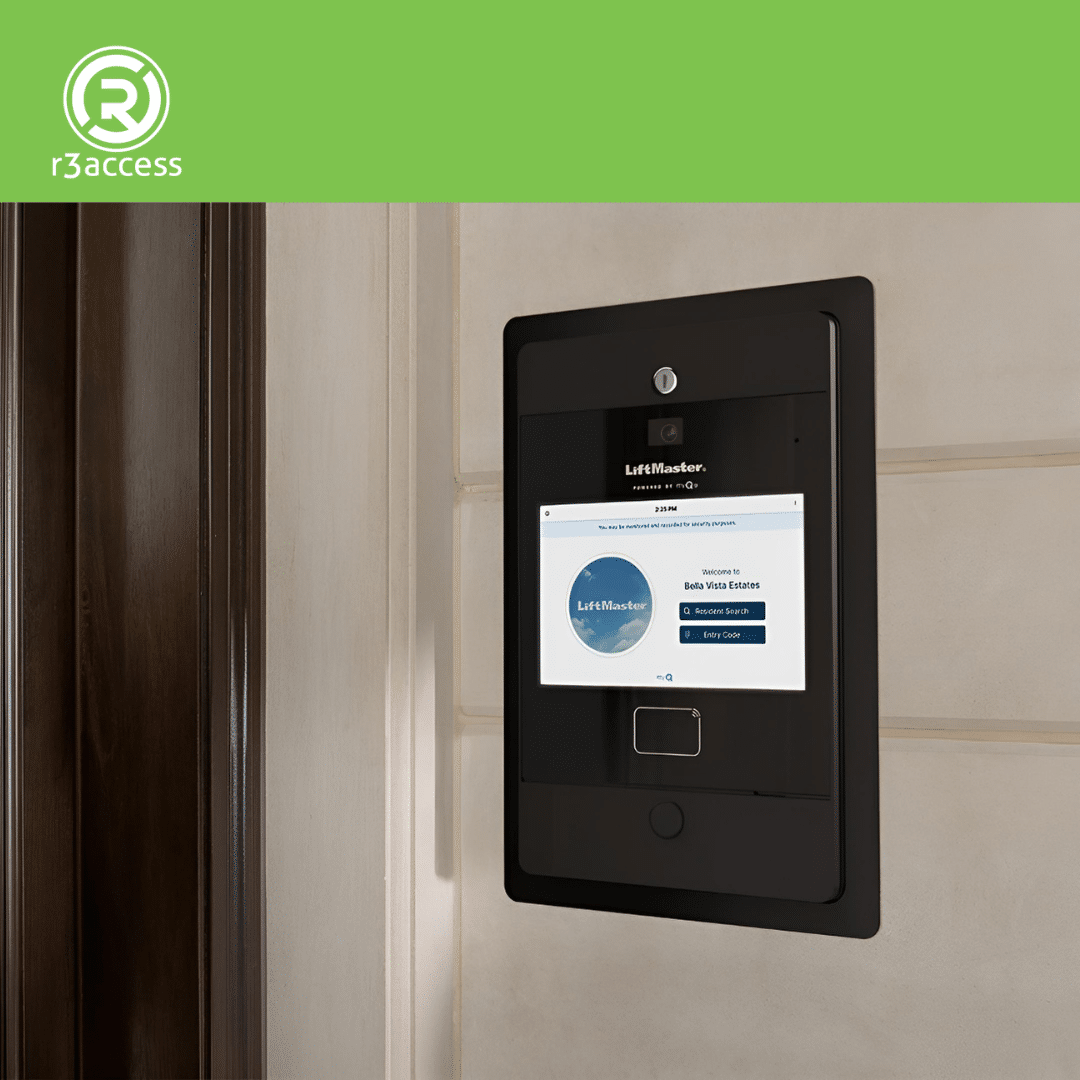
- The Call: The driver uses the smart intercom directory at the gate.
- The Routing: The system routes the call directly to the property manager’s cell phone or a central security office via VOIP or cellular data.
- Visual Verification: The manager sees a live video feed of the truck right on their phone screen.
- Remote Trigger: The manager taps a button on their app, sending an immediate signal to the LiftMaster gate operator.
- Entry: The gate arm lifts, the truck rolls through, and the event is logged automatically in the cloud.
The manager didn’t need to be anywhere near the property to handle that delivery safely. They could have been at home, at a different job site, or even out of town. It just works.
Overcoming Structural and Power Challenges
Every building is different. Some older commercial sites have thick concrete walls that block wireless signals easily, while others might cover acres of land where running long communication wires would cost a small fortune in trenching costs.
This is why looking over blueprints and project specifications before buying any hardware is incredibly critical. A common mistake many people make is purchasing an access system online, only to discover during installation that the property’s current electrical setup can’t support it, or that they lack the proper data cables.
Working with experts who understand hardware compatibility ensures you pick the right mix of hard-wired components for heavy-duty main gates and wireless or cellular-based units for distant perimeter access points. You want to make sure the structural layout matches your equipment choices perfectly before anyone turns a wrench.
Scaling Up Without Starting Over
Properties change over time. You might start by managing a single warehouse, and three years later, your business expands to include an adjacent storage yard and a new office building.
If you installed a localized, proprietary access system on day one, expanding usually means tearing everything out and starting completely from scratch. It’s expensive and annoying.
A centralized, cloud-oriented LiftMaster system scales up effortlessly. If you add a new gate or another commercial door down the road, you just install the compatible LiftMaster operator, hook it up to the network, and add it to your existing online dashboard. The core management platform stays exactly the same, whether you are running one gate or fifty entry points spread across the region.
Choosing the Right Foundation
Securing a commercial or residential property is kind of a balancing act between convenience and dependable protection, right? If you shift over to a centralized access system, you stop doing the whole constant running around, you reduce security risks, and you get a crystal clear record of each person who steps foot onto your property, or at least that’s the idea.
Picking professional-grade equipment also matters, because your physical gates and doors should react immediately every single time a cloud signal tells them to open. Then when your hardware stays dependable, and your software is centralized, managing property security stops feeling like a daily grind; it becomes a smoother, quieter background process that pretty much takes care of itself.
If you are currently mapping out a brand new security project, upgrading an aging system, or trying to solve a tricky installation layout for your facility, getting professional guidance on your blueprints can save you thousands in avoided errors. To explore high-quality equipment options and view reliable entry solutions, check out the resources available at R3 Access.
FAQs
How does LiftMaster Access Control help manage multiple properties at once?
LiftMaster access systems can link up with modern cloud management software. Instead of managing each gate or door locally on a single computer at the property, the entry points connect to the internet via Ethernet or cellular networks. This lets property managers log into a single centralized online dashboard from anywhere to update tenant codes, view entry logs, and check gate status across multiple locations instantly.
Can wireless and wired access components be combined in a single system?
Yes, they can. Many large or complex commercial facilities use a hybrid setup. You might have a heavy-duty hard-wired connection for a main entrance gate close to the building’s power supply, while using wireless or cellular units for distant perimeter gates or secondary doors where running long data cables would be too expensive. A unified management portal allows both types of hardware to work together seamlessly.
What happens to the access control logs if the internet goes down?
Modern smart controllers are built with internal memory storage. If the property loses its cloud network connection temporarily, the LiftMaster system still functions locally using the last synchronized data. It will continue to grant entry to authorized users and store the access events locally. Once the internet connection is restored, the hardware automatically uploads the stored logs back to the central cloud database.
Why is UL325 compliance important for automatic gate installations?
UL325 is the top safety standard in the country for automated doors and gate operators. Compliance ensures the equipment includes necessary safety features, like auto-reverse functions and sensing edges, to prevent accidents or injuries when a gate is opening or closing. Using certified hardware protects the safety of users and helps property owners minimize potential legal liabilities.
How do smart intercoms reduce the daily workload for property managers?
Smart intercoms route visitor calls directly to cell phones or central offices using cellular or VOIP connections. Instead of requiring a guard to sit in a booth at the gate or forcing the property manager to physically travel down to the site, visitors can be visually verified via video feeds and granted access remotely with a quick tap on a smartphone app.