

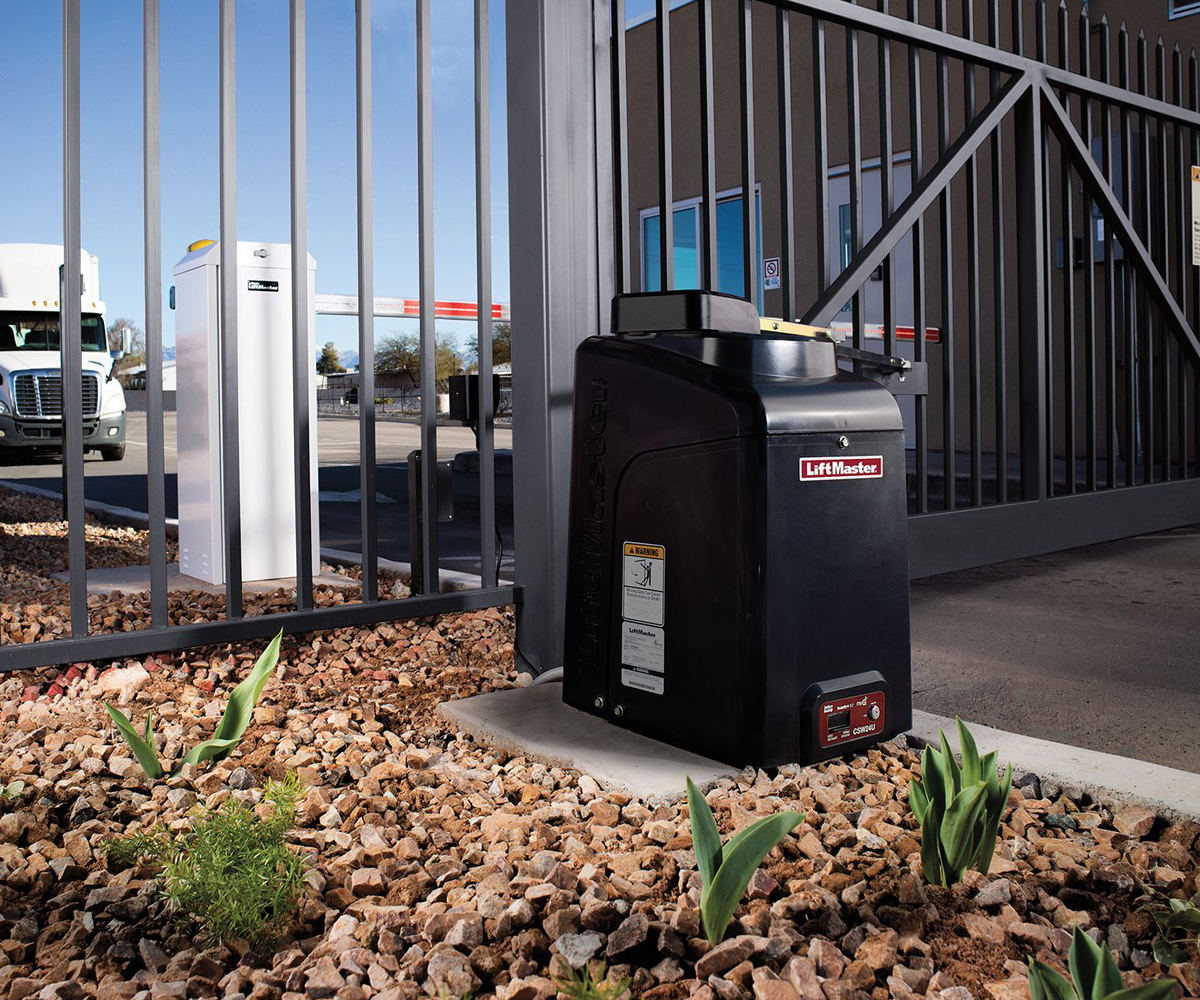
What Are Barrier Gate Operators?
Upgrade Slide Gate Operators | Trusted Brands
Think of a barrier gate operator as the physical muscle built to control traffic lanes using a motorized, pivoting arm. The whole process is quick: a vehicle pulls up, presents a valid badge or trips an underground sensor, and the motor pops the arm up out of the way. Once the car passes over the safety loops, the system drops the arm right back down to close off the roadway.
These aren’t like giant slide gates or swing fences that shut down an entire perimeter line. Barrier operators are specialized tools built strictly for speed and non-stop cycling. You place them at specific checkpoints where you need to manage traffic flow and hold drivers accountable one by one.
Where You’ll See Them Installed
- Logistics hubs & freight yards (sorting massive semi-truck lines)
- Commercial parking structures and paid hourly public lots
- Corporate office parks and executive garage setups
- Manufacturing plants, heavy industrial sites, and warehouses
- High-volume toll plazas and transit authority checkpoints
- Government buildings and restricted municipal yards
- University campuses and school parking zones
- Gated neighborhoods and large apartment complexes
- Airports and busy train or bus terminals
- Critical infrastructure sites like utility substations


Upgrade Slide Gate Operators | Trusted Brands
Because they open incredibly fast, don’t take up much space, and run with high mechanical efficiency, these automated barrier setups are the gold standard for modern vehicle access control.
Security Barriers and Gates Designed for High-Traffic Environments
Upgrade Slide Gate Operators | Trusted Brands
Every commercial property deals with a totally different kind of traffic nightmare. A boutique office building might only see a handful of cars slip through the gate every hour, but a major distribution center or a downtown parking deck has to process thousands of vehicles a day. That massive gap in daily usage is exactly why picking the right grade of security barrier is so critical.
Security Directors Love Commercial-Grade Barrier Gate Systems Because They Solve Real-World Operational Headache
- They clear out lane backups: Fast open-and-close cycles get cars through the checkpoint fast, keeping traffic from spilling back onto public streets.
- They enforce actual gate rules: Hooking these units up to card readers means only authorized people pass the line.
- They sort out messy multi-lane setups: Motorized arms keep lane discipline crystal clear at busy, confusing entrances.
- They block tailgaters: Physical arms force unverified drivers to a full stop, killing casual drive-through security breaches.
- They link up with modern software: These units bridge the gap between heavy metal hardware and cloud-based security programs.
If your facility can’t afford gate downtime or messy traffic jams at the front entrance, commercial barrier operators give you a tough, time-tested solution.
Why Barrier Gate Operators Are Popular for Commercial and Industrial Properties
Industrial and commercial facilities face access hurdles that residential gate motors just can’t handle. During any given shift, an entrance has to manage a messy mix of employee cars, huge freight trucks, contractors, visitors, and emergency vehicles. Utilizing high-performance barrier gate operators lets companies build an organized, accountable entry process without killing their daily business speed.
Real-World Use Cases:
- Warehouses & Freight Hubs: Keeps incoming semi-truck lines completely separate from everyday employee parking lots.
- Corporate Office Structures: Delivers touchless entry for monthly pass holders while keeping guest access under control.
- Manufacturing Facilities: Validates vendors, shift workers, and supply trucks at the outer perimeter before they ever get close to the main building.
- Public Parking Lots: Automates payment collection points and stops ticket fraud or tailgating completely.
- Government & Military Complexes: Sets up a reliable first line of defense for restricted, high-security zones.
- Hospitals & College Campuses: Safeguards reserved staff spaces while keeping critical emergency lanes wide open.
Because these rugged operators are built from scratch to survive millions of continuous cycles, they are the absolute go-to choice for any location experiencing heavy traffic.
Integrating Barrier Gate Operators With Access Control Systems
A barrier operator really shows its value when it acts as the muscle behind an intelligent access control setup. Instead of running on an island, modern barrier units connect seamlessly with a massive array of tracking and authentication tech.
Common system tie-ins include:
- Proximity Cards & RFID Readers: Staff just wave a badge or key fob to trigger an instant opening.
- Digital Keypads: Perfect for giving temporary PIN codes to delivery drivers or repair techs.
- Telephone Entry Systems: Let visitors quickly call an office desk to get a remote gate release.
- IP Intercoms: Gives you real-time audio and sharp video verification before letting anyone in.
- In-Ground Vehicle Loops: Use underground electromagnetic fields to trigger the gate or stop the arm from crushing a car.
- License Plate Recognition (LPR): High-speed cameras read plates on approach, opening up instantly for approved vehicles.
- Mobile Apps: Gives users the ability to trigger the barrier using Bluetooth or smartphone apps.
By pairing tough physical barriers with smart digital access tools, property managers get complete data visibility and total control over who crosses their perimeter.
Choosing the Right Barrier Gate Operator
Finding the perfect barrier operator means breaking down a few unique site variables. Security challenges shift from one property to the next, so a cookie-cutter approach to gate hardware is a recipe for disaster.
What to Look at Before Buying:
- Daily Traffic Numbers: Look closely at peak rush hours and total expected daily cycles to figure out if you need a light-commercial setup or a heavy-duty industrial motor.
- Lane Width: The physical length of your gate arm dictates how much motor torque and counterbalancing weight you need to lift it safely.
- Your Current Tech Framework: You have to make sure the new operator’s control board can communicate perfectly with your current software and readers.
- The Local Weather: Figure out if the hardware needs internal heaters for freezing winters or special coatings to fight off coastal humidity and rust.
- How Fast You Need It to Open: Decide if your application requires an ultra-fast 1.5-second opening cycle or a standard 4-second lift.
- Room to Grow: Plan ahead for potential site growth, like adding a second lane or multi-tiered security check-ins down the road.
Answering these questions early saves you from expensive installation mistakes and ensures long-term hardware reliability.
Why Work With R3 Access?
With security tech evolving so fast, picking the right barrier gate operator can feel like a lot to handle, especially when trying to connect heavy iron hardware with cloud-based digital networks. R3 Access makes this easy by looking at every single project through a practical, real-world lens.
Our Approach to Your Project:
- We analyze your exact physical property layout.
- We study your real-world traffic flow patterns.
- We align equipment with your corporate security and risk management goals.
- We integrate directly with your current access control infrastructure.
- We plan for long-term scalability and future operational upgrades.
Whether you are designing a brand-new commercial complex or trying to fix an old, broken entry gate, our team is here to help you find rugged, worry-free vehicle access management solutions that actually work.
Ready to Fix Your Property's Access Control?
FAQ
It’s a motorized access-control gadget made to handle vehicle flow by moving a visible barrier arm up and down across the road, and yeah, you’ll usually spot them at parking garages. Also at corporate entryways, and at industrial checkpoints where security teams need a steady way to oversee cars coming in or exiting the property.
It starts when the operator gets an authorized signal from an access device like a card reader, keypad, or vehicle loop. The internal electric motor engages a gearbox to quickly swing the barrier arm up vertically. Once the car drives through and clears the safety sensors, the control board tells the motor to safely drop the arm back down.
You’ll find them anywhere with steady, high-volume vehicle turnover. Common locations include public parking decks, corporate office complexes, warehouses, logistics yards, and gated residential communities. They are also crucial for managing liability and traffic at airports, university lots, and hospital emergency lanes.
They sort out traffic flow pretty fast by automating the validation side of things and dropping those manual gate delays. They also raise the security level a bit by setting up a physical checkpoint that makes trespassers think twice, and it also helps cut back tailgating. On top of that, they bring down payroll costs by swapping out manual guards, and they start tracking useful entry data when they’re hooked into newer access software, you know.
Yes, commercial-grade barrier operators are built for nonstop duty, tough conditions, honestly. Unlike a typical residential gate motor, which can overheat if it’s cycled again and again, these commercial units rely on brushless DC motors and oil-bath gearboxes that stay manageable even while operating thousands of times in a day.
This is a broad category of physical hardware built to restrict, monitor, and manage vehicle access into a secure property. This includes everything from lightweight, fast-cycling parking arms used to manage traffic to heavy-duty, crash-rated anti-ram barriers built to protect critical infrastructure from hostile vehicles.
Yeah, commercial-grade barrier gates are engineered, like, specifically for continuous duty in those pretty punishing settings, you know. Instead of a typical residential gate motor that tends to overheat if it gets switched on and off too often, these commercial systems lean on brushless DC motors and an oil bath style gearbox, which stays relatively calm temperature-wise even while they’re operating thousands of runs in a single day.
Start by looking at your daily traffic volume and required opening speeds. Next, measure the exact width of your traffic lane, since longer lanes require heavier arms that need specialized high-torque motors. Finally, consider your local weather conditions and make sure the internal electronics match your existing software.
They act as the main physical enforcement tool for parking revenue setups. They connect directly with ticket dispensers, payment kiosks, and validation systems. When a customer pays their fee or scans a valid pass, the system instantly tells the barrier operator to raise the arm, keeping business moving automatically.
To keep your operator running smoothly and safely, we strongly suggest a routine, preventive maintenance schedule. Look at how worn the internal gears are, try the belt tension, make sure oil levels are right, and re-tighten the hardware twice a year; it really helps a lot. Technicians should also periodically check the safety circuits, just to be sure the arm reverses right away if there is any obstacle.
Public safety is a massive focus for modern barrier systems. They come standard with auto-reverse logic that immediately stops and raises the arm if it hits any resistance on the way down. They also integrate with underground vehicle loops, photoelectric safety eyes, and high-visibility flashing LED lights built right into the arm.
Yes, matching barrier gates with license plate recognition (LPR) technology is incredibly popular right now. High-def cameras scan a vehicle’s plate as it approaches, checking it against an approved database in milliseconds. If it’s a match, the gate lifts automatically without the driver ever having to roll down their window.
Industrial sites are high-liability areas with lots of moving parts, semi-trucks, vendor vans, and massive shifts of employee vehicles. Barrier gates create instant lane discipline, keeping unverified vehicles out of dangerous work zones while ensuring logistics schedules keep moving without costly delays.